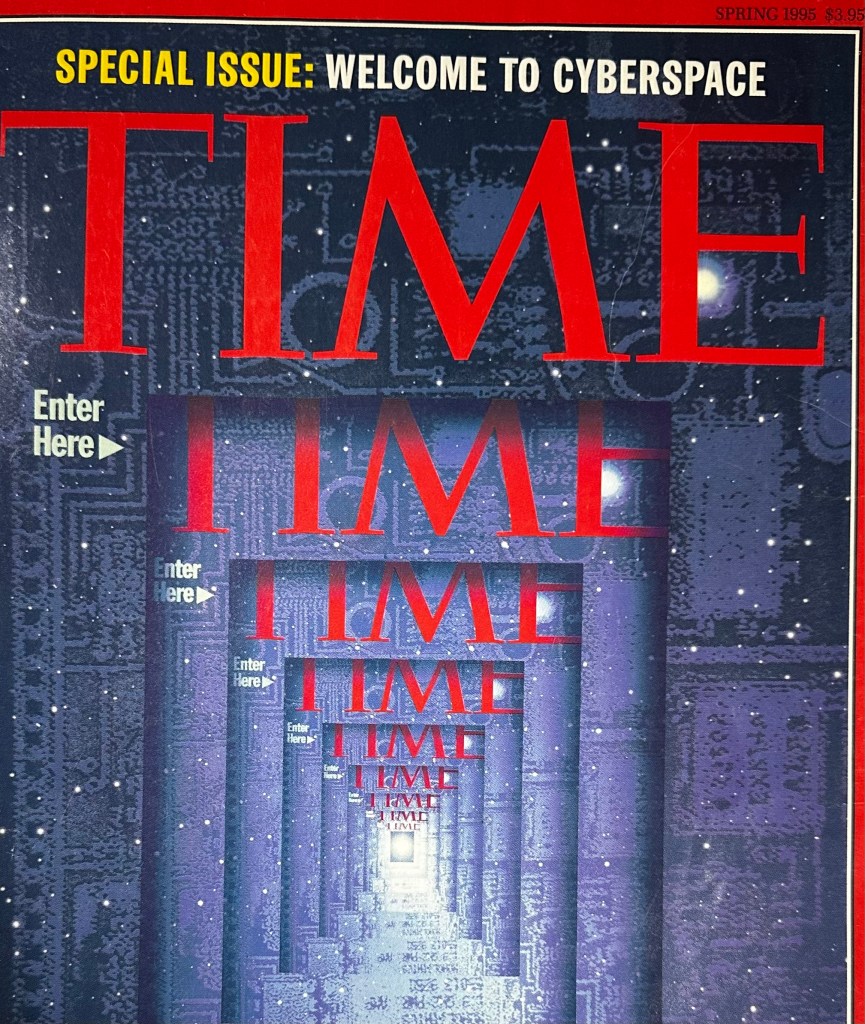
For Generation X, it’s hard to believe it’s “only” been 30 years since Time Magazine welcomed us to cyberspace. My three kids are convinced it was always there, like indoor plumbing and school shootings.
In 1995, Time was the second most-read weekly magazine in the U.S., just behind People Magazine, which regularly featured deep-dive profiles of people like Jay Leno, the cast of “Friends” and Hootie & The Blowfish — and likely still does. (C’mon, who misses Hootie?)
With millions of weekly readers, Time’s influence on Everyday America was enormous and profound. So when Time published its guide to “cyberspace” in the Spring of 1995 I knew I had to put it in a box somewhere for safe keeping. I was 29 years old at the time – just about half my age today—and I was a bit of a news magazine packrat.
I came across this 30-year-old artifact tonight in a burst of decluttering. And now, instead of continuing my housecleaning, I feel compelled to share the wisdom Time imparted back when Gen X was begging its parents for an AOL or Prodigy account. This “special issue” of Time got a lot right, and a lot wrong. Well, maybe not “wrong” — but certainly “cringe-inducing” in retrospect from our sophisticated, social media-addled, AI-soaked vantage point 30 years later.
Enjoy these quotes and excerpts, and judge for yourself:
- “What is cyberspace?…It can be defined most succinctly as ‘that place you are in when you are talking on the phone’.”
- “Some newspapers, including the Raleigh NC News and Observer, give their reporters free Internet accounts and encourage them to use them.”
- “I probably should have recognized the first signs of cyberaddiction. My phone bill edged over $100 a month.”
- “I did send the Fax from the plane. Really, I did.”
- “In a virtual office, paper has disappeared—and so have most employees.”
- “Cybernaut.”
- “Cops on the I-Way.”
- “The ‘Global Village’ is coming, but everyone will reach it at a different pace.”
- “Modem: The device that allows a computer to transmit information over a phone line.”
- “Posting: A Message – perhaps yours – on a bulletin board.”
- “Much of what has been written about it—in the press and on the networks—tends to swing from one extreme to the other, from hype and romanticism to fear and loathing. It may be that the near-term impact of cyberspace is being oversold. But that does not mean that real change isn’t in the works. As a rule of thumb, historians say, the results of technological innovation always take longer to reach fruition than early champions of change predict. But when change finally comes its effect is likely to be more profound and widespread and unanticipated than anyone imagined—even the guys who write science fiction.”
Like the kids used to ask from the backseat of the mini-van: are we there yet?
Almost 100 years ago, Time Magazine readers were educated about this suddenly accessible thing called “radio.”

Today, AI (Perplexity, my latest drug of choice) tells me that Time Magazine’s readership “has experienced a catastrophic decline of approximately 75% since 1995, falling from an estimated 4 million circulation to just one million today.”
Here’s its recent cover story about AI:

Imagine what our kids will be reading about in the year 2055?
 David Grady: Words and Pictures
Leave a comment